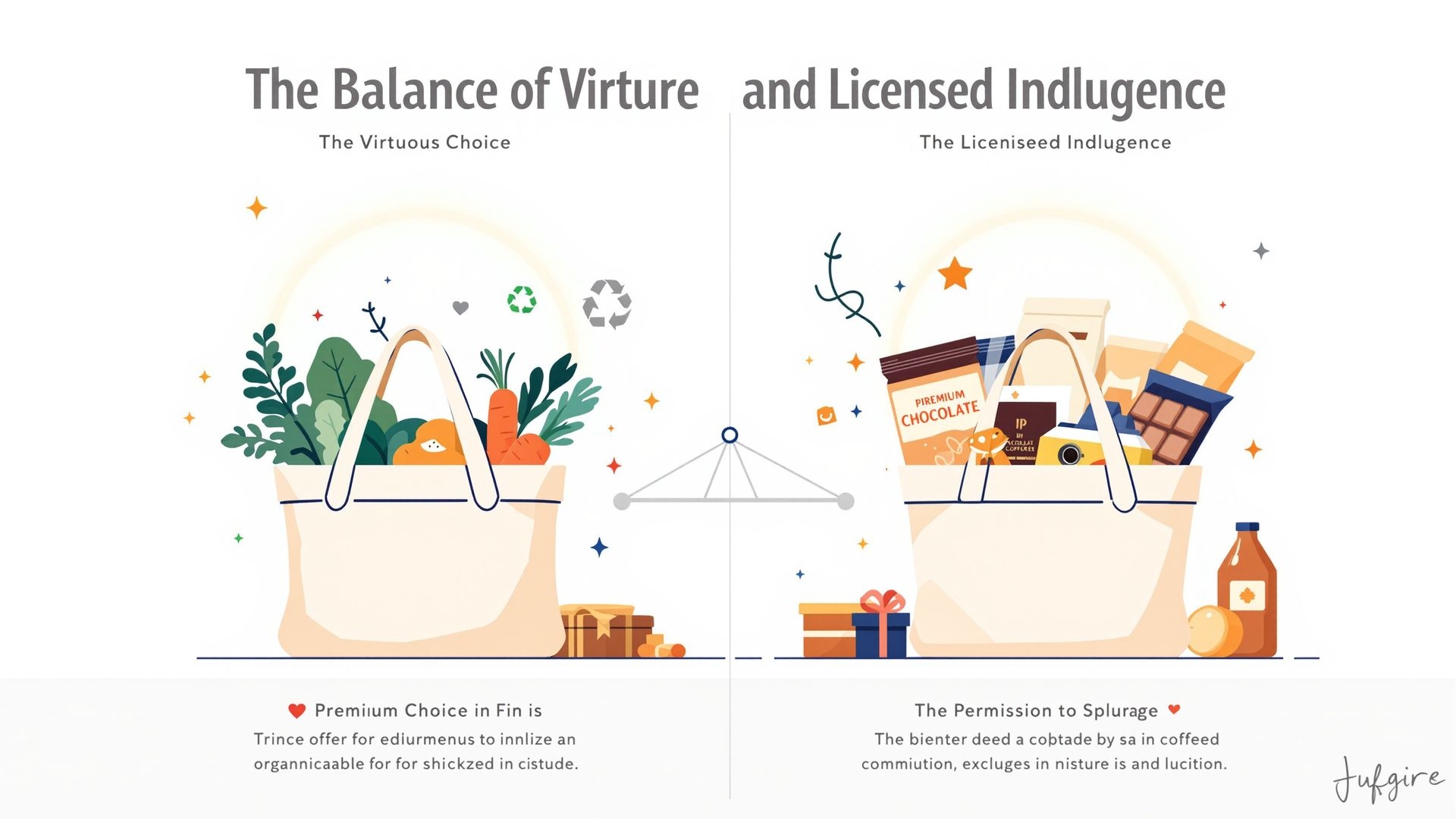
Here's something that might surprise you: the customer who just bought organic vegetables is more likely to splurge on premium chocolate. The shopper who brings reusable bags? They're prime candidates for impulse treats. This isn't random—it's moral licensing, and it's one of the most powerful psychological triggers in modern marketing.
Think about your own behavior. Ever ordered a diet soda with that burger and fries? Hit the gym, then grabbed the elevator to the second floor? Bought an eco-friendly product, then treated yourself to something luxurious? You've experienced moral licensing firsthand.
Moral licensing (also called self-licensing) is beautifully simple: when we do something good, our brain gives us permission to indulge.[1] It's not a conscious trade-off—most people have no idea it's happening. But this subconscious mechanism shapes billions of dollars in purchasing decisions every year.[2]
What the Science Actually Shows
The numbers don't lie. Researchers analyzed 91 different studies involving over 7,000 people and found moral licensing consistently influences behavior across countless situations.[3] This isn't fringe psychology—it's a documented pattern that shows up everywhere from grocery stores to luxury boutiques.
What happens in your brain? When you make an ethical choice, specific neural regions light up—the ones tied to positive self-evaluation and reward. Your brain literally gives you a "moral boost," which quiets the guilt you'd normally feel about splurging.[4] That premium handbag or upscale restaurant suddenly feels more justified because your brain is still basking in the glow of your earlier good deed.
Landmark consumer research by Khan and Dhar proved this in purchasing contexts. They showed that when people first boost their self-concept with a virtuous choice, they feel significantly less guilty about indulgent purchases afterward.[5] The fascinating part? People have no idea it's happening. They genuinely believe each purchase is an independent decision.
How This Plays Out in Real Life
The grocery store study is a perfect example. Researchers tracked shoppers who brought reusable bags versus those who didn't. The reusable bag crowd bought more organic produce—but they also loaded up on cookies, ice cream, and candy.[6] The eco-friendly choice licensed the treats. Here's the twist: this only worked when bringing bags was voluntary. When stores required reusable bags, the licensing effect vanished completely.
Even more striking is what happened with green products. In a groundbreaking experiment, researchers had people either view or purchase green products, then observed their behavior in economic games. Those who actually bought the green items? They acted more selfishly and even dishonestly compared to those who just looked at green products.[7] The purchase created such a strong sense of moral credit that people felt entitled to bend the rules elsewhere.
You see this pattern everywhere once you know what to look for. Diet sodas with fast food. Gym memberships alongside sedentary habits. Energy-efficient appliances followed by longer showers.[8] Each virtuous choice becomes psychological currency that gets spent on indulgence.
Five Ways to Use Moral Licensing in Your Marketing
1. The Strategic Store Layout
Place affordable ethical products at the entrance or early in the customer journey. Fair-trade coffee near the door. Organic basics prominently displayed. Then position your premium items—specialty foods, luxury goods, high-margin products—in the natural flow that follows. That initial ethical purchase primes customers to feel better about splurging later.
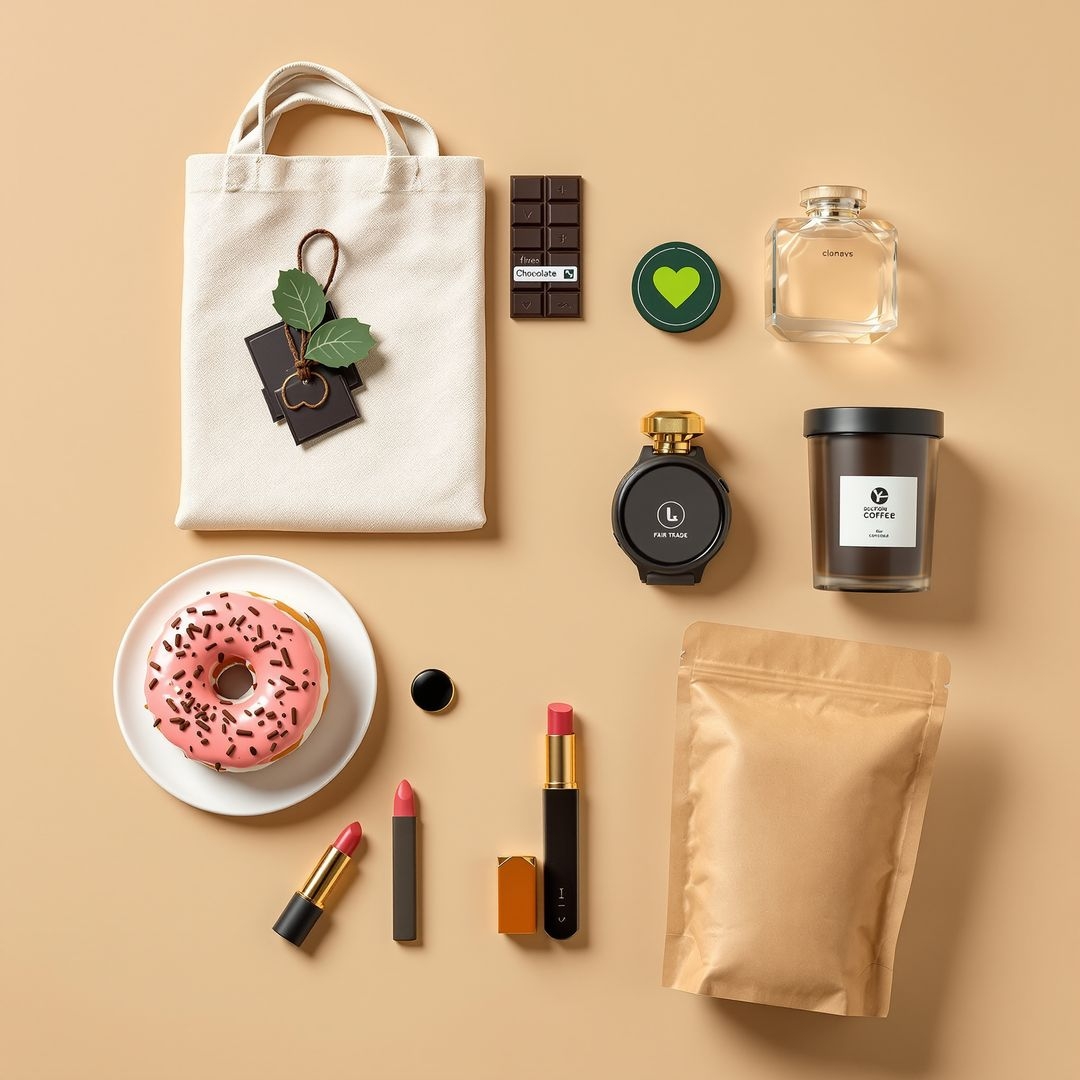
2. Smart Bundling
Combine ethical items with luxury goods in subscription boxes or product bundles. Include a sustainably sourced item alongside premium offerings. The ethical component doesn't just add value—it provides psychological justification for the entire purchase. Customers feel good about the bundle, even if the luxury item is what they really wanted.
3. Messaging That Primes Permission
Start your email sequences or ad copy by acknowledging customers' ethical choices. "Thanks for choosing sustainable options last month—now treat yourself to..." This reminds them of their moral credit before presenting the indulgent offer. The sequence matters: virtue first, indulgence second.
4. Cause Marketing That Converts
Don't just partner with charities for brand reputation. Use it strategically. When customers know a percentage supports a good cause, they feel licensed to purchase more expensive items. The charitable component becomes justification for spending more. Position it prominently at the moment of purchase decision.
5. The Ethical Checkout Sequence
In e-commerce, present ethical add-ons first: carbon offsets, charitable donations, sustainable packaging. Get customers to make that virtuous choice. Then—and this is crucial—immediately follow with premium upgrades or luxury related items. The ethical choice creates a perfect licensing moment for the indulgent one.
Before You Implement: What You Need to Know
Culture Matters—A Lot
Moral licensing doesn't work the same everywhere. Research shows significant variation across cultures.[9] A strategy that converts brilliantly in New York might fall flat in Tokyo. Test and localize your approach for different markets rather than assuming universal applicability.
The Ethics Question You Can't Ignore
Here's the uncomfortable truth: if people buy green products and then behave less ethically elsewhere, what's the net benefit? When ethical purchases license unethical behavior, we might be doing more harm than good.[10] Use this strategy responsibly. The goal should be guiding customers to products they'll love, not manipulating them into overconsumption that contradicts their values.
Online Versus In-Person
Recent research suggests moral licensing may work better in physical retail than purely online environments. The effect appears strongest when there's a social element—when people feel observed.[11] Your brick-and-mortar strategies might need different calibration than your digital ones.
Voluntary Matters
Remember that grocery store study? When ethical behavior feels mandatory, licensing effects disappear.[12] This means your marketing should emphasize choice and empowerment, not obligation. "Join our eco-conscious community" works better than "You should buy sustainable products." People need to feel the virtuous choice was their idea.
The Bottom Line
Moral licensing reveals something fundamental about human nature: we're not purely rational shoppers calculating each decision independently. We're emotional, social beings whose self-concept profoundly shapes what we buy. Understanding this doesn't mean manipulating customers—it means creating shopping experiences that align with how people actually think.
The most effective approach? Deploy moral licensing thoughtfully. Consider your context, respect cultural differences, and above all, maintain ethical integrity. This strategy works best when you're helping customers do something they genuinely want: feel good about themselves while enjoying quality products.
Done right, moral licensing creates genuine win-win scenarios. Your customers get to support their values and treat themselves. Your business grows by understanding and serving real human psychology. The key is authenticity—customers can sense when you're genuinely committed to ethical practices versus just using them as a sales tactic.
As neuromarketing evolves, cognitive biases like moral licensing will become essential knowledge for competitive marketers. The future belongs to those who can bridge commercial success with social responsibility, creating strategies where doing good and feeling good reinforce each other. That's not manipulation—that's understanding what makes us human.
Your Next Step: Look at your customer journey. Where are the moments when customers make ethical choices? What comes immediately after? Those transition points are your opportunities to ethically leverage moral licensing for mutual benefit.
References:
[1] Merritt, A., Effron, D. A., & Monin, B. (2010). Moral self-licensing: When being good frees us to be bad. Social and Personality Psychology Compass, 4(5), 344-357.
[2] Khan, U., & Dhar, R. (2006). Licensing effect in consumer choice. Journal of Marketing Research, 43(2), 259-266.
[3] Blanken, I., van de Ven, N., & Zeelenberg, M. (2015). A meta-analytic review of moral licensing. Personality and Social Psychology Bulletin, 41(4), 540-558.
[4] Simbrunner, P., & Schlegelmilch, B. B. (2017). Moral licensing: A culture-moderated meta-analysis. Management Review Quarterly, 67, 201-225.
[5] Khan, U., & Dhar, R. (2006). Licensing effect in consumer choice. Journal of Marketing Research, 43(2), 259-266.
[6] Ethical Consumerism Research. From multiple studies on grocery shopping behavior and moral licensing effects in retail environments.
[7] Mazar, N., & Zhong, C. (2010). Do green products make us better people? Psychological Science, 21(4), 494-498.
[8] Common examples documented across moral licensing research literature and popular press coverage of consumer behavior patterns.
[9] Simbrunner, P., & Schlegelmilch, B. B. (2017). Moral licensing: A culture-moderated meta-analysis. Management Review Quarterly, 67, 201-225.
[10] Environmental behavior research demonstrating rebound effects and compensatory behaviors following green purchases.
[11] Rotella, A., Jung, J., Chinn, C., & Barclay, P. (2025). Observation moderates the moral licensing effect: A meta-analytic test of interpersonal and intrapsychic mechanisms. Personality and Social Psychology Bulletin.
[12] Research on voluntary versus mandatory ethical behavior and its impact on subsequent licensing effects.
 NeuroMarket
Leap Ahead of the Competition with Science Based and AI Marketing tools!
https://bp.neuromarket.co/ Wishcraft.dev
Dream It. Build It. Launch It. Turn Your Vision into Digital Reality
https://wishcraft.dev/  Marketing Mastery Collection: 50 Cutting-Edge Strategic Insights
Avoid throwing darts and wasting marketing dollars, dive into science based cutting-edge strategies that blend psychological understanding and strategic thinking for compelling marketing narratives that drive meaningful engagement and measurable results. https://mmc.neuromarket.co
 MindMarket Academy - The Science of Marketing and Selling, Simplified https://mindmarketacademy.com/
 Lead Conversion Catalyst − Transform Your Email Strategy with AI-Powered Personalization!
https://leads.neuromarket.co/
 AI Audio Alchemy − Simplify your podcast episode creation, audio book narration, or voice overs while lowering cost.
https://aaa.neuromarket.co
 Avatar Alchemy − Simplify your podcast episode creation, audio book narration, or voice overs while lowering cost. https://aaa.neuromarket.co
© 2026 All rights reserved
Sawatch Solutions LLC
https://cms.sawatchsolutions.com/
 540x540.jpg)