
Here's a truth most marketers overlook: your audience isn't reading your copy with one mind — they're using two.
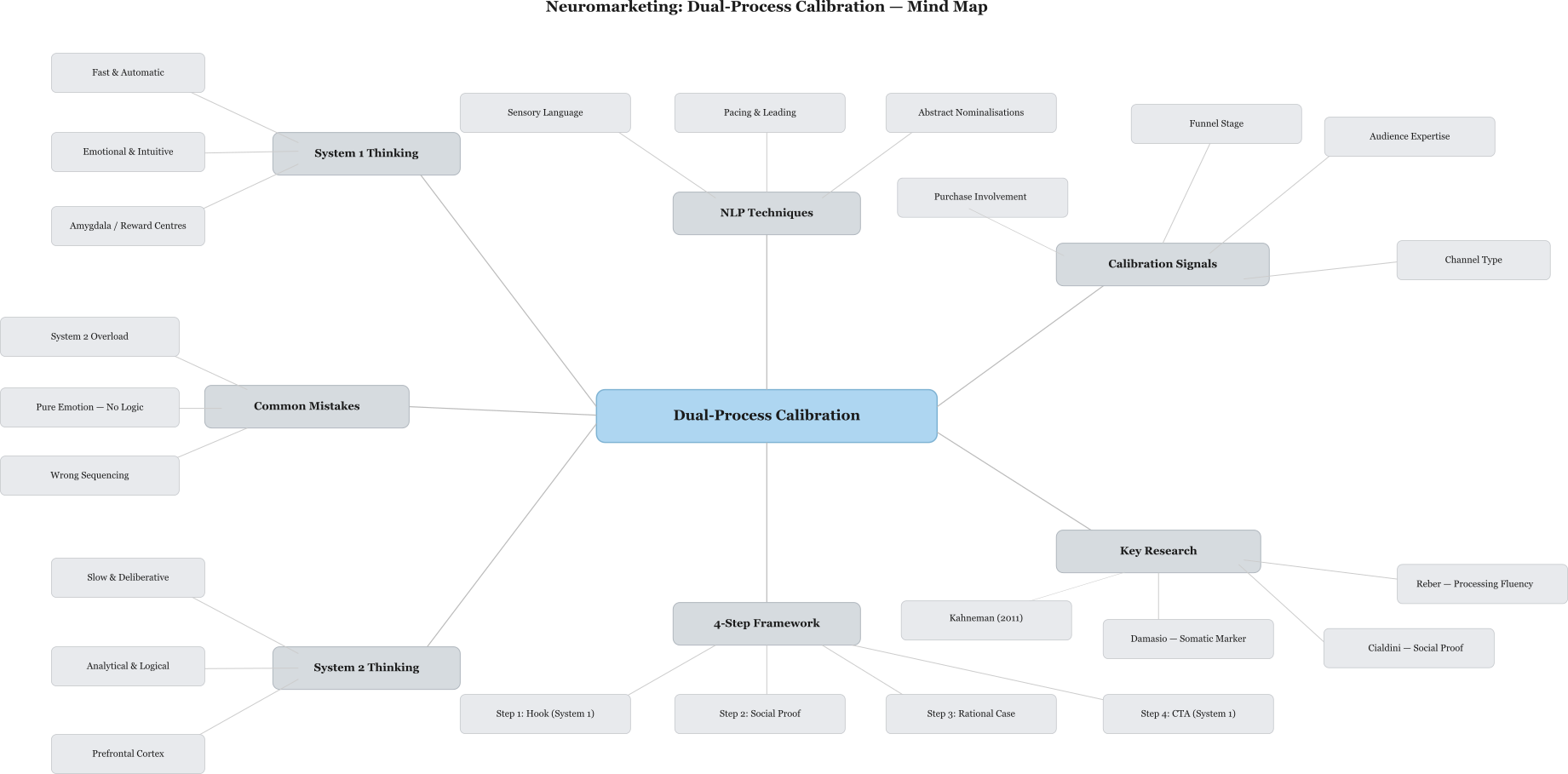
One is fast, emotional, and automatic. The other is slow, logical, and deliberate. Understanding how to speak to both — at the right moments, in the right sequence — is one of the most powerful skills in neuromarketing.
It's called Dual-Process Calibration. And once you see it, you can't unsee it.
In 2011, Nobel Prize-winning psychologist Daniel Kahneman gave the world a framework that changed how we understand human decisions.² He called them System 1 and System 2.
System 1 never clocks off. It's running right now — processing your environment, triggering emotions, making instant judgements. It's why you feel uncomfortable before you can explain why. It's why a bold red headline stops the scroll. It decides in milliseconds.³
System 2 is the part that reads the fine print. It compares options, evaluates evidence, and builds the case for a decision. It's slower, it's effortful — and it's easily fatigued.
Here's what matters for your marketing: System 1 is the gatekeeper. If your message doesn't trigger an emotional or instinctive response first, System 2 never gets involved. Logic without feeling doesn't get read — it gets skipped.
Mistake #1: Drowning people in logic.
Feature lists. Technical specs. Rational value propositions. These are System 2 content — but they're being served to a System 1 audience. Kahneman calls us "cognitive misers."⁵ We take shortcuts. We skim. And we reach for the delete key.

Mistake #2: Going pure emotion with no rational backup.
Emotional hooks grab attention — but without logical scaffolding, they create anxiety rather than action. Research consistently shows that while emotion drives the impulse to buy, rational justification is what completes the purchase — especially for high-ticket decisions.⁶ People feel first, then they build their reasons.⁷ Your job is to hand them those reasons, ready-made.
fMRI studies have mapped exactly where these systems live in the brain. System 1 activates the amygdala and reward centres — emotion, habit, gut instinct.⁸ System 2 fires up the prefrontal cortex — analysis, working memory, executive decision-making.⁹
But here's the part that changes everything: neuroscientist Antonio Damasio found that these systems don't compete — emotion drives rational thinking.¹⁰ Patients who lost emotional processing couldn't make decisions at all, even simple ones, despite having fully intact analytical brains. Feeling isn't the enemy of reason. It's the engine.
NLP (Neuro-Linguistic Programming) gives us practical tools here. Sensory language — "feel the difference," "picture yourself there," "sharp as a knife" — activates System 1 immediately.¹¹ Abstract language — "strategic alignment," "optimise ROI," "incremental value" — requires System 2 to unpack it.
The technique NLP calls "pacing and leading"¹² is the master move: match your audience's emotional state first (System 1), then introduce logic (System 2). You pace before you lead.
Think of how Apple does it. "Think Different" — three seconds, pure identity, pure System 1. Then you scroll to the product page: benchmarks, specs, comparisons. System 2, fully served. The emotional yes comes first. The rational confirmation follows.¹³
Step 1 — Hook with System 1 Your headline, hero image, or opening line must create instant emotional recognition. Use concrete, vivid, sensory language. Address a pain or desire directly. Don't explain yet — connect.
Step 2 — Bridge with Social Proof Testimonials and case studies work on both systems simultaneously. They're emotionally compelling and rationally credible. Cialdini's research shows they reduce cognitive load while delivering evidence.¹⁴ Use them as your transition between feeling and thinking.
Step 3 — Build the Rational Case Now that you have attention and trust, give System 2 what it needs: organised evidence, clear structure, logical flow. Well-organised content is processed more fluently — and research shows we associate fluency with credibility.¹⁵ Make it easy to think through, and your audience will trust it more.
Step 4 — Close with System 1 Return to emotion at the call-to-action. Urgency. Aspiration. Belonging. "Join 50,000 professionals transforming their marketing" consistently outperforms "Submit your details" — because it speaks identity, not administration.¹⁶
A few quick calibration guides:
Dual-Process Calibration isn't a one-time trick — it's an ongoing audit of everything you publish. The question to ask every piece of content: Which system does this primarily address, and does the sequence serve where my audience is in their journey?
The brands that master this make the gut say yes — and then give the brain exactly what it needs to confirm it.
As Kahneman observed, confidence in a belief isn't determined by the quality of the evidence behind it.² That gap — between feeling and fact — is precisely where exceptional marketing does its best work.
References
¹ Evans, J.S.B.T. (2008). Dual-processing accounts of reasoning, judgment and social cognition. Annual Review of Psychology, 59, 255–278.
² Kahneman, D. (2011). Thinking, Fast and Slow. Farrar, Straus and Giroux.
³ Potter, M.C., et al. (2014). Detecting meaning in RSVP at 13 ms per picture. Attention, Perception, & Psychophysics, 76(2), 270–279.
⁴ Ambady, N., & Rosenthal, R. (1992). Thin slices of expressive behavior as predictors of interpersonal consequences. Psychological Bulletin, 111(2), 256–274.
⁵ Fiske, S.T., & Taylor, S.E. (1991). Social Cognition: From Brains to Culture. McGraw-Hill.
⁶ Nielsen Norman Group (2016). Emotion in UX: The Role of Rational and Emotional Design. Nielsen Norman Group Research Report.
⁷ Festinger, L. (1957). A Theory of Cognitive Dissonance. Stanford University Press.
⁸ Bechara, A., & Damasio, A.R. (2005). The somatic marker hypothesis: A neural theory of economic decision. Games and Economic Behavior, 52(2), 336–372.
⁹ Miller, E.K., & Cohen, J.D. (2001). An integrative theory of prefrontal cortex function. Annual Review of Neuroscience, 24, 167–202.
¹⁰ Damasio, A.R. (1994). Descartes' Error: Emotion, Reason and the Human Brain. Putnam.
¹¹ Bandler, R., & Grinder, J. (1975). The Structure of Magic I. Science and Behavior Books.
¹² O'Connor, J., & Seymour, J. (1990). Introducing NLP. Mandala.
¹³ Lindstrom, M. (2010). Buyology: Truth and Lies About Why We Buy. Crown Business.
¹⁴ Cialdini, R.B. (2001). Influence: The Psychology of Persuasion. HarperCollins.
¹⁵ Reber, R., Schwarz, N., & Winkielman, P. (2004). Processing fluency and aesthetic pleasure: Is beauty in the perceiver's processing experience? Personality and Social Psychology Review, 8(4), 364–382.
¹⁶ Optimizely (2022). CTA Optimization Report: Emotional vs. Neutral Language in E-commerce. Optimizely Research.
¹⁷ Alba, J.W., & Hutchinson, J.W. (1987). Dimensions of consumer expertise. Journal of Consumer Research, 13(4), 411–454.
Listen to the “Neuromarketing Playbook Podcast” at https://mysoundwise.com/soundcasts/1770335640163s

NeuroMarket
Leap Ahead of the Competition with Science Based and AI Marketing tools!
https://bp.neuromarket.co/

Wishcraft.dev
Dream It. Build It. Launch It. Turn Your Vision into Digital Reality
https://wishcraft.dev/

Marketing Mastery Collection: 50 Cutting-Edge Strategic Insights
Avoid throwing darts and wasting marketing dollars, dive into science based cutting-edge strategies that blend psychological understanding and strategic thinking for compelling marketing narratives that drive meaningful engagement and measurable results. https://mmc.neuromarket.co

MindMarket Academy - The Science of Marketing and Selling, Simplified
https://mindmarketacademy.com/
Lead Conversion Catalyst − Transform Your Email Strategy with AI-Powered Personalization!
https://leads.neuromarket.co/

AI Audio Alchemy − Simplify your podcast episode creation, audio book narration, or voice overs while lowering cost.
https://aaa.neuromarket.co

Avatar Alchemy − Simplify your podcast episode creation, audio book narration, or voice overs while lowering cost.
https://aaa.neuromarket.co

Neuromarketing Playbook Podcast https://mysoundwise.com/episodes/17726752192371323e
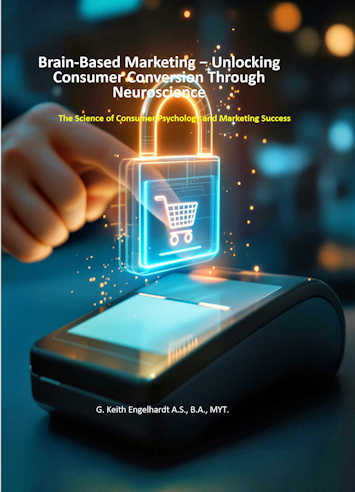
Brain-Based Marketing: Unlocking Consumer Conversion Through Neuroscience
In this book, Keith Engelhardt shares practical, effective, and easy to implement brain science-based marketing tips so that marketing, product, and experience design can more effectively capture and focus attention, determine preferences, and understand purchasing behavior. Their goals center on optimizing how businesses and brands communicate, design, and position offerings and achieve better marketing results.
ISBN: 979-8-90243-266-1 (223 pages)
Information about the book and purchasing the book is available at https://cms.sawatchsolutions.com/brain-based-marketing-unlocking-consumer-conversion-through-neuroscience/
© 2026 All rights reserved
Sawatch Solutions LLC
https://cms.sawatchsolutions.com/
 540x540.jpg)